 By Hemant Sharma
 The ocean covers more than 70% of Earth’s surface, yet humans have explored only a tiny fraction of it. Beneath the waves exists a world so strange and diverse that it often feels more like science fiction than nature. Sea animals live under extreme pressure, darkness, cold, and isolation—conditions that would instantly kill most land creatures.
To survive, marine life evolved extraordinary abilities: glowing bodies, giant sizes, invisible camouflage, and senses humans don’t possess. These ten amazing facts reveal how sea animals are some of the most incredible life forms on the planet—and how little we still know about them.
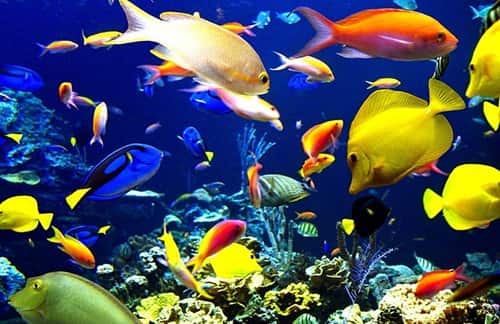
1. Most Sea Animals Have Never Been Seen by Humans
The majority of ocean life remains undiscovered.
Scientists estimate that over 80% of the ocean is unexplored, and thousands of marine species are discovered every year. Many creatures live so deep that sunlight never reaches them, making exploration difficult and expensive.
This means some of the strangest sea animals on Earth are still completely unknown—living and evolving without ever being observed by humans.
2. The Blue Whale Is the Largest Animal Ever to Exist
The blue whale is bigger than any dinosaur ever was.
It can grow up to 30 meters long and weigh over 150 tons. Its heart alone can weigh as much as a small car, and its blood vessels are so wide that a human could theoretically swim through them.
What’s even more amazing is that such a massive creature survives mostly on tiny krill. Size in the ocean follows very different rules than on land.
3. Some Sea Animals Glow in the Dark
Many deep-sea animals produce their own light.
This ability, called bioluminescence, is used for communication, camouflage, hunting, and defense. Jellyfish, squid, fish, and plankton can glow blue, green, or even red.
In the deep ocean, light is a survival tool. Glowing can attract prey, confuse predators, or make an animal nearly invisible by matching the faint light from above.
4. Octopuses Are Among the Smartest Animals on Earth
Octopuses have remarkable intelligence.
They can solve puzzles, open jars, escape tanks, and recognize individual humans. Their brains are unique—over half of their neurons are located in their arms, allowing each arm to act semi-independently.
Octopuses can also change color and texture instantly, blending perfectly into their surroundings. Intelligence and camouflage work together as powerful survival tools.
5. Some Fish Can Change Gender
In the ocean, gender is not always fixed.
Certain fish species can change sex during their lifetime. This usually happens when population balance is disturbed—for example, if there are too many males or females.
This ability increases survival and reproduction chances. Nature prioritizes balance over rigid rules.
6. Sea Animals Can Survive Extreme Pressure
Deep-sea animals live under crushing pressure.
At great depths, pressure can be hundreds of times stronger than at sea level. Humans would be crushed instantly, but deep-sea animals have flexible bodies, no air-filled spaces, and special proteins that function under pressure.
Their bodies are designed not to resist pressure—but to live with it.
7. Sharks Are Older Than Trees
Sharks have existed for over 400 million years.
That means sharks were swimming in oceans long before trees appeared on land. They survived mass extinctions that wiped out countless species.
Their design—cartilage skeletons, sharp senses, and efficient movement—proved so effective that evolution barely needed to change them.
8. Dolphins Have Names for Each Other
Dolphins use unique sounds to identify individuals.
Each dolphin develops a specific whistle that acts like a name. Other dolphins recognize and respond to it, even after years of separation.
This shows advanced social intelligence and communication—something very rare in the animal kingdom.
9. Coral Reefs Are Built by Tiny Animals
Coral reefs look like colorful underwater cities, but they are made by tiny creatures.
Corals are living animals that build hard skeletons over time. These structures support entire ecosystems, providing food and shelter for thousands of species.
Despite covering less than 1% of the ocean floor, coral reefs support about 25% of all marine life.
10. Sea Animals Feel Pain and Emotion More Than We Thought
Modern research shows many sea animals experience pain and stress.
Fish, for example, show behavioral and neurological responses consistent with pain. Some marine animals also form bonds, show curiosity, and display learning behavior.
This challenges old assumptions and reminds us that intelligence and emotion are not limited to land animals.
Conclusion
Sea animals are not just creatures of water—they are masterpieces of evolution. They adapted to darkness, pressure, distance, and isolation in ways that stretch human imagination. From giants like whales to glowing plankton, the ocean is filled with life forms that redefine what survival looks like.
What makes this even more incredible is how much remains unknown. Every deep-sea dive reveals something new. Every discovery reminds us that Earth still holds mysteries beyond our reach.
The ocean is not silent or empty. It is alive, intelligent, and astonishing—and sea animals are proof that life can thrive in the most extreme conditions imaginable.