 By Hemant Sharma
 India is a paradise for bird lovers. From Himalayan valleys to desert grasslands, from mangrove forests to wetlands, the country is home to hundreds of bird species. But behind this beauty, a serious crisis is growing. Many birds that once filled Indian skies are now seen only in small pockets. Some are down to a few hundred individuals. Some have not been reliably recorded for years. Some are dying because their grasslands are being converted, wetlands are shrinking, forests are being cut, and power lines, pesticides and toxic veterinary drugs are silently killing them.
The State of India’s Birds 2023 assessment studied 942 bird species found in India and classified 178 species as High Conservation Priority. It also found that 204 species have declined over the long term, showing that bird conservation is no longer a small issue.
Here are the top 10 endangered birds in India in 2026, selected mainly on the basis of IUCN threat status, rarity, population decline, and importance for Indian biodiversity.
1. Great Indian Bustard
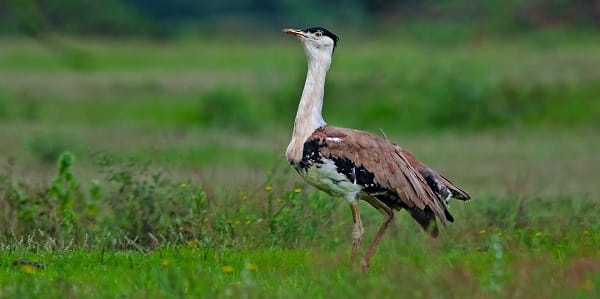
The Great Indian Bustard, also called Godawan, is one of India’s most critically endangered birds. It was once found across dry grasslands and scrublands of western and central India, but today its stronghold is mainly Rajasthan, with a very small presence in Gujarat.
This bird is large, elegant and one of the heaviest flying birds in the world. Its biggest threats are grassland loss, hunting in the past, disturbance, and collisions with overhead power lines. In 2026, Rajasthan’s breeding programme continued to bring hope, but the wild population remains extremely low. Recent reports mention over 130 birds in the wild, with most of the global population surviving around Jaisalmer.
Status: Critically Endangered
Main areas: Rajasthan, Gujarat
Major threats: Power lines, grassland loss, disturbance
2. Lesser Florican
The Lesser Florican, locally known as Kharmor or Likh, is one of India’s most dramatic grassland birds. During the monsoon breeding season, the male jumps repeatedly above tall grass to attract females. This beautiful display has also given it the nickname “grass peacock.”
Sadly, the species is now close to extinction. BirdLife says the Lesser Florican qualifies as Critically Endangered, and recent WII-linked reports estimated only about 150–200 individuals remaining, with very few males recorded during the 2025 breeding season.
Its biggest problem is the destruction of semi-arid grasslands. Many of its breeding grounds have become farms, grazing lands, roads or development zones. Mechanised farming, pesticides, stray dogs and power lines add more pressure.
Status: Critically Endangered
Main areas: Rajasthan, Gujarat, Madhya Pradesh
Major threats: Grassland loss, farming, pesticides, dogs
3. Bengal Florican
The Bengal Florican is another rare bustard of India’s grasslands. It is found mainly in the tall wet grasslands of Assam, Uttar Pradesh and parts of the Terai belt. It is one of the rarest bustards in the world and depends on healthy floodplain grasslands.
BirdLife lists the Bengal Florican as Critically Endangered because of its small and declining population, with estimates from India in the range of 250–999 mature individuals.
The biggest threat is habitat loss. Tall grasslands are often converted into farms, settlements or plantations. Even inside protected areas, grassland management is important because wrong burning, grazing or invasive plants can damage breeding habitat.
Status: Critically Endangered
Main areas: Assam, Uttar Pradesh, Arunachal region
Major threats: Grassland conversion, habitat fragmentation, disturbance
4. Jerdon’s Courser
Jerdon’s Courser is one of India’s most mysterious birds. It is a nocturnal bird found only in India, mainly linked with scrub forests of Andhra Pradesh and Telangana. For many decades, it was believed to be extinct until it was rediscovered in 1986.
BirdLife describes it as Critically Endangered and notes that despite search efforts, it has not been recorded since 2008/2009. The Nature Conservation Foundation also describes Jerdon’s Courser as a critically endangered bird found only in Andhra Pradesh and Telangana.
Its habitat is dry scrubland with open patches, but such land is often treated as wasteland and diverted for roads, canals, plantations and development. This is one reason the bird has become so hard to find.
Status: Critically Endangered
Main areas: Andhra Pradesh, Telangana
Major threats: Scrub forest loss, development projects, very small range
5. White-bellied Heron
The White-bellied Heron is one of the rarest herons in the world. In India, it is found mainly in Arunachal Pradesh, especially along undisturbed rivers and forested valleys. It is a large, shy bird that depends on clean river systems.
BirdLife classifies it as Critically Endangered because it has an extremely small and rapidly declining population. A 2024 study on the species in Namdapha Tiger Reserve described it as having fewer than 60 individuals remaining globally.
Hydropower projects, river disturbance, fishing pressure, habitat loss and human activity are major threats. Since the bird needs quiet river stretches, even small changes in river ecology can affect its survival.
Status: Critically Endangered
Main area: Arunachal Pradesh
Major threats: River disturbance, hydropower, habitat loss
6. Forest Owlet
The Forest Owlet is a small owl found only in central India. It is one of India’s most special endemic birds. The species disappeared from records for more than 100 years and was rediscovered in 1997.
The Forest Owlet is listed as Endangered, and conservation organisations note that it is found in limited locations in Madhya Pradesh, Maharashtra and Gujarat. It prefers dry deciduous forests, especially teak-bearing habitats.
Its main threat is forest loss and degradation. Unlike many owls, it can be active during the day, which makes it easier to observe when present. But because its range is so limited, any destruction of suitable forest can seriously harm the species.
Status: Endangered
Main areas: Madhya Pradesh, Maharashtra, Gujarat
Major threats: Deforestation, habitat fragmentation
7. White-rumped Vulture
The White-rumped Vulture was once one of the most common large birds of prey in India. Today, it is Critically Endangered. Its population crashed mainly because of diclofenac, a veterinary painkiller used in cattle. When vultures fed on carcasses of treated cattle, the drug caused kidney failure and death.
BirdLife says the White-rumped Vulture has suffered an extremely rapid population decline of more than 99% over three generations. A 2025 Wildlife Institute of India report recorded 945 nests across 12 states, with 890 active nests, and estimated a minimum of 1,780–1,890 breeding adults.
Status: Critically Endangered
Main areas: North, central and eastern India pockets
Major threats: Toxic veterinary drugs, food scarcity, nesting site loss
8. Indian Vulture
The Indian Vulture, also called the Long-billed Vulture, is another victim of the vulture crisis in India. It is found mainly in rocky cliffs, old forts, dry landscapes and parts of central and western India.
BirdLife cites an estimate of around 12,000 individuals based on 2015 road transects, roughly equal to about 8,000 mature individuals. The species remains Critically Endangered because its decline was extremely steep and the dangers from unsafe veterinary drugs have not fully disappeared.
Conservation breeding, safe food zones and drug control are essential for its recovery. Vultures are not just birds; they are natural cleaners that stop disease from spreading through dead animals.
Status: Critically Endangered
Main areas: Rajasthan, Gujarat, Madhya Pradesh, Maharashtra
Major threats: Diclofenac-like drugs, poisoning, nesting disturbance
9. Red-headed Vulture
The Red-headed Vulture, also called Asian King Vulture, is easily recognised by its bare red head and dark body. It was once found widely across the Indian subcontinent, but its numbers have declined sharply.
BirdLife lists the Red-headed Vulture as a threatened species and notes that recent studies found the decline in India had slowed and may even be reversing in some areas after the diclofenac ban. Still, it remains Critically Endangered and needs strong protection.
This bird usually prefers open country, dry forests and areas where animal carcasses are available. Like other vultures, it depends on safe food and undisturbed nesting sites.
Status: Critically Endangered
Main areas: Central, western and northern India pockets
Major threats: Toxic veterinary drugs, food shortage, habitat disturbance
10. Spoon-billed Sandpiper
The Spoon-billed Sandpiper is not a resident Indian bird, but it is an extremely rare winter migrant and passage visitor. Its spoon-shaped bill makes it one of the most unique shorebirds in the world. It breeds in Russia and migrates through East and South Asia.
In 2026, this bird made news after being photographed near Bakkhali in West Bengal, only the second photographic record from the state. Reports said the global population is now around 500 individuals and declining because of habitat destruction along migration routes and hunting pressure in wintering areas.
For India, coastal mudflats and wetlands are important because even rare migrants need safe stopover and feeding sites.
Status: Critically Endangered
Main Indian sightings: West Bengal coast, occasional coastal records
Major threats: Loss of mudflats, migration-route disturbance, hunting outside India
Conclusion
India’s endangered birds tell us one clear truth: saving birds means saving habitats. Grasslands, wetlands, rivers, scrub forests, cliffs and mudflats all need protection. If these birds disappear, India will lose not only rare species, but also a part of its natural identity.