 By Hemant Sharma
 Ants are easy to ignore because they are small, silent, and always busy. But once you look closely, they turn out to be some of the most successful creatures on Earth. They lived alongside dinosaurs, survived mass extinctions, and spread to almost every landmass on the planet.
What makes ants fascinating is not their size, but their organization. They build cities underground, run complex societies, communicate without sound, and work together in ways humans still study today. These ten facts reveal why ants are far more remarkable than they appear.
1. Ants Have Been Around for Over 100 Million Years
Ants existed when dinosaurs still walked the Earth. Fossil evidence shows that ants appeared more than 100 million years ago during the age of reptiles.
While dinosaurs vanished, ants adapted. Their small size, social living, and ability to survive on limited resources helped them outlast many larger animals. They are a living example of survival through cooperation.
2. There Are More Ants Than Humans on Earth
Scientists estimate that ants make up a massive portion of all land animal biomass. In simple terms, if you could weigh all ants together, their combined weight would rival or even exceed that of all humans combined.
This is not because ants are heavy, but because there are so many of them. They live on every continent except Antarctica and thrive in forests, deserts, cities, and farms.
3. Ant Colonies Work Like Superorganisms
An ant colony behaves like a single living body. Each ant has a specific role, similar to organs in a body.
Workers gather food, soldiers defend the colony, nurses care for young ants, and the queen focuses on reproduction. No single ant controls the colony, yet everything runs smoothly through instinct and communication.
4. The Queen Ant Can Live for Decades
Most people think insects live only a few weeks or months. Queen ants break that rule completely. Some queen ants can live for 20 to 30 years under the right conditions.
During her lifetime, a queen may lay millions of eggs. She rarely leaves the nest and is protected by workers at all times. Her long life ensures stability for the colony.
5. Ants Do Not Sleep Like Humans
Ants do not sleep in long stretches the way humans do. Instead, they take short rest periods throughout the day and night.
These power-rests last only minutes, but they are enough to keep ants active around the clock. This system allows colonies to function continuously without shutting down.
6. Ants Communicate Using Chemicals
Ants do not talk or make sounds to communicate. They use pheromones, which are chemical signals released into the air or onto surfaces.
Through these signals, ants can warn of danger, mark food trails, call for help, or signal the presence of the queen. A single scent trail can guide hundreds of ants to food with surprising accuracy.
7. Ants Can Carry Many Times Their Own Weight
One of the most famous facts about ants is their strength. Some ants can carry objects 10 to 50 times their own body weight.
This strength comes from their body structure. Ants are small, so their muscles can lift relatively heavier loads compared to their size. It’s the same reason a small crane can lift more than a giant one proportionally.
8. Ants Practice Farming and Herding
Certain ant species farm fungus as their primary food source. They carefully grow it, protect it from disease, and remove unwanted growth—just like human farmers.
Other ants herd aphids, protecting them from predators in exchange for a sugary substance aphids produce. This form of mutual benefit shows how advanced ant behavior can be.
9. Ants Can Build Living Bridges
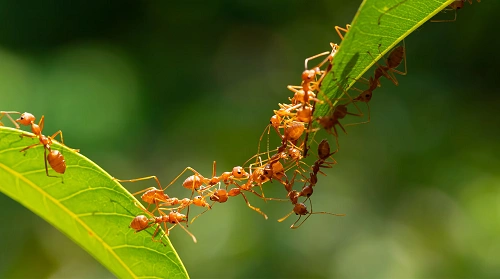
When ants need to cross gaps, they sometimes link their bodies together to form living bridges. Each ant grips the next, creating a flexible structure that other ants can walk across.
What’s remarkable is that ants adjust these bridges in real time, adding or removing ants to make the bridge more efficient. This behavior shows problem-solving without central planning.
10. Ants Play a Major Role in Ecosystems
Ants are natural cleaners and soil engineers. They break down organic waste, recycle nutrients, and improve soil quality by tunneling underground.
Their tunnels allow air and water to reach plant roots more easily. Without ants, many ecosystems would struggle to stay healthy. Small as they are, ants quietly support life around them.
Conclusion
Ants prove that size has nothing to do with importance. Through cooperation, discipline, and adaptability, they have become one of the most dominant life forms on Earth.
The next time you see ants marching across the ground, remember this: you are watching an ancient, intelligent system at work—one that humans are still trying to understand.