 By Hemant Sharma
 The Earth may look like one continuous surface from space, but it is divided into massive landmasses we call continents. These continents are not just pieces of land—they are worlds of their own, shaped by tectonic forces, climate, history, and life. Every continent tells a different story about how the planet evolved and how humans adapted to it.
From frozen wastelands to dense rainforests, from ancient civilizations to untouched wilderness, continents define the diversity of Earth. These ten interesting facts reveal how continents differ, connect, and surprise us in ways most people never think about.
1. There Are Seven Continents—But Not Everyone Agrees
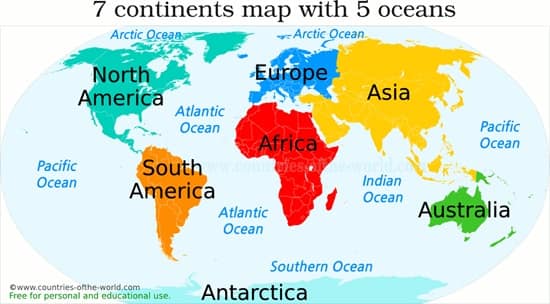
Most people learn that Earth has seven continents: Asia, Africa, North America, South America, Europe, Australia, and Antarctica.
However, this classification depends on historical and cultural views. Some countries teach that Europe and Asia together form one continent called Eurasia. Others combine North and South America into a single continent.
This means the idea of “continents” is partly scientific and partly human-made. Nature doesn’t draw borders—humans do.
2. Asia Is the Largest and Most Populated Continent
Asia is massive in every sense.
It covers about 30% of Earth’s land surface and is home to more than half of the world’s population. Asia contains the highest mountain (Mount Everest), some of the oldest civilizations, and the widest range of climates.
From frozen Siberia to tropical Southeast Asia, no other continent matches Asia’s scale or diversity.
3. Africa Is the Birthplace of Humanity
Africa holds a special place in human history.
The oldest human fossils were found here, showing that modern humans originated in Africa before spreading across the globe. In that sense, Africa is the ancestral homeland of all people alive today.
It is also the second-largest continent and one of the richest in natural resources, cultures, and languages.
4. Antarctica Has No Permanent Human Population
Antarctica is the coldest, driest, and windiest continent on Earth.
No one lives there permanently. Only scientists and researchers stay temporarily in research stations. Temperatures can drop below –80°C, making survival nearly impossible without advanced technology.
Despite this, Antarctica plays a huge role in regulating Earth’s climate and ocean systems.
5. Europe Is Small but Historically Powerful
Europe is one of the smallest continents by size.
Yet its influence on global history is enormous. European nations shaped modern politics, science, industry, and global trade. Many modern laws, education systems, and political ideas trace their roots back to Europe.
Size doesn’t determine impact—and Europe proves that clearly.
6. Australia Is Both a Country and a Continent
Australia is unique.
It is the only continent that is also a single country. Australia is known for its isolation, which allowed wildlife to evolve in unusual ways. Animals like kangaroos and koalas are found nowhere else naturally.
Its long separation from other landmasses shaped a completely distinct ecosystem.
7. North America Has Almost Every Climate Type
North America contains extreme climate diversity.
It has frozen tundra in the north, deserts in the south, rainforests, grasslands, mountains, and long coastlines. This range allowed many different cultures and ecosystems to develop.
Few continents offer such environmental variety within one landmass.
8. South America Is Home to the World’s Largest Rainforest
South America hosts the Amazon Rainforest.
This rainforest produces a significant portion of Earth’s oxygen and is one of the most biodiverse places on the planet. Millions of species live there, many still undiscovered.
South America also contains the Andes Mountains, one of the longest mountain ranges in the world.
9. Continents Are Constantly Moving
Continents are not fixed in place.
They move slowly due to tectonic plate movement—about the speed fingernails grow. Millions of years ago, all continents were joined together as a single landmass called Pangaea.
This movement causes earthquakes, volcanoes, and mountain formation. The Earth’s surface is alive and changing, even if we don’t notice it day to day.
10. Continents Shape Culture and Identity
Where people live shapes how they live.
Continents influence food habits, clothing, architecture, language, and belief systems. Climate affects lifestyle. Geography affects trade and conflict. History grows from land.
Understanding continents helps us understand why the world is so diverse—and why no single way of living fits everyone.
Conclusion
Continents are more than geography lessons on a map. They are the foundation of Earth’s diversity—natural, cultural, and historical. Each continent carries a unique combination of climate, life, and human story shaped over millions of years.
By learning about continents, we don’t just learn where places are—we learn why the world looks the way it does today. From shifting plates to ancient migrations, continents remind us that Earth is dynamic, interconnected, and far more complex than it appears.