 By Hemant Sharma
 The world we live in feels familiar, yet it is full of surprises. Every country, ocean, mountain, and culture hides stories that most people never hear about. We walk on this planet every day without realizing how strange, complex, and fascinating it truly is. From nature’s quiet wonders to human-made mysteries, the world constantly reminds us that there is far more happening beyond our daily routines. Below are 15 carefully chosen, interesting facts about the world.
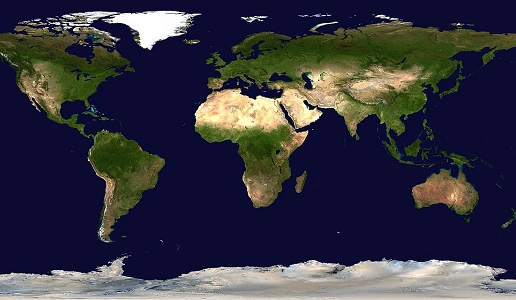
1. Earth is not a perfect sphere
Most people imagine Earth as a smooth, round ball. In reality, it is slightly flattened at the poles and bulges at the equator. This happens because Earth rotates, and that rotation pushes mass outward. Scientists call this shape an “oblate spheroid,” which sounds complex but simply means Earth is a little squashed.
2. Most of the planet is still unexplored
Despite satellites and advanced technology, a large part of Earth remains unexplored. Deep oceans, underground cave systems, dense rainforests, and remote polar regions are still full of unknown species and hidden landscapes. Humans know more about the surface of the Moon than the deepest parts of Earth’s oceans.
3. Water covers most of the world, but little is usable
About 71% of Earth’s surface is covered by water. Yet, only a small fraction of it is fresh water suitable for drinking. Most of Earth’s water is salty ocean water, and much of the fresh water is locked away in glaciers and ice caps, making clean water far more precious than it appears.
4. Time moves differently around the world
Time zones exist because Earth rotates. When it is morning in one country, it can be night in another. There are places on Earth where you can cross a border and suddenly enter a different day. This makes the idea of “time” feel very real and very strange at the same time.
5. Some places on Earth never see sunlight for months
In regions near the poles, there are periods when the Sun does not rise at all for weeks or even months. This phenomenon is known as polar night. On the opposite side of the year, the Sun may never set, creating endless daylight. These extreme conditions shape how people live in such regions.
6. The world has thousands of languages
There are over 7,000 spoken languages in the world today. Some are spoken by millions, while others are known only to a few hundred people. Language shapes how people think, express emotions, and understand reality. Sadly, many languages are disappearing as cultures change.
7. Borders are human ideas, not natural ones
Mountains, rivers, and oceans existed long before countries. Political borders are created by humans through history, wars, and agreements. From space, there are no visible lines dividing nations—only one continuous planet.
8. Earth’s atmosphere protects life quietly
The atmosphere is invisible, yet it is one of the most important parts of our world. It shields Earth from harmful radiation, burns up meteors before they reach the ground, and regulates temperature. Without it, life as we know it would not survive.
9. Some sounds on Earth travel unbelievably far
In certain conditions, sound can travel hundreds of kilometers. Explosions, volcanic eruptions, and massive natural events have been heard far beyond where they occurred. The world can feel silent, but it carries sound in surprising ways.
10. The planet is constantly changing
Earth is never still. Continents slowly drift, mountains rise, oceans expand and shrink, and climates shift over time. These changes happen so slowly that humans barely notice them, but over millions of years, they completely reshape the world.
11. Humans have reached almost every corner of Earth
From the highest mountains to the coldest poles and the deepest oceans, humans have left footprints almost everywhere. This shows human curiosity and determination—but it also reminds us of our responsibility to protect what we explore.
12. Nature often creates perfect patterns
Snowflakes, honeycombs, seashells, and even hurricanes follow mathematical patterns. These shapes are not designed by humans, yet they appear precise and balanced. Nature seems to follow hidden rules that scientists are still trying to fully understand.
13. The world looks different depending on where you stand
The same sunrise can feel peaceful in one place and dramatic in another. Geography, culture, and personal experience shape how people see the world. Reality stays the same, but perception changes based on perspective.
14. Earth has survived massive disasters before
Throughout its history, Earth has faced asteroid impacts, ice ages, massive volcanic eruptions, and mass extinctions. Life did not disappear—it adapted and returned in new forms. This shows both the planet’s vulnerability and its resilience.
15. The world is shared by billions of stories
Every person on Earth lives a completely different life. Billions of dreams, fears, struggles, and hopes exist at the same time. The world is not just land and water—it is a collection of human experiences happening all at once.
Final Thoughts
The world is far more than a place we live in. It is a moving, breathing system shaped by time, nature, and humanity. The more we learn about it, the more we realize how little we truly know. Every mountain, language, ocean, and culture adds another layer to the planet’s story. Understanding these facts does not just make us smarter—it makes us more aware, more humble, and more connected to the world we call home.