 By Hemant Sharma
 On 23 August 2023, India quietly made history. No dramatic countdown echoes across the world. No loud declarations. Just a calm voice from mission control and a nation holding its breath. When Chandrayaan-3’s lander touched the Moon’s surface, India became the first country to land near the Moon’s south pole and the fourth nation ever to achieve a soft landing on the Moon.
But Chandrayaan-3 was more than a landing. It was a comeback. After the partial failure of Chandrayaan-2 in 2019, many space agencies would have hesitated. ISRO didn’t. Instead, it learned, redesigned, simplified, and returned stronger. The result was a mission that combined smart engineering, careful planning, and quiet confidence.
What makes Chandrayaan-3 truly fascinating is not just where it landed, but how and why it was done. From cost efficiency to scientific ambition, every part of the mission tells a story. Let’s explore the top 10 interesting facts about Chandrayaan-3.
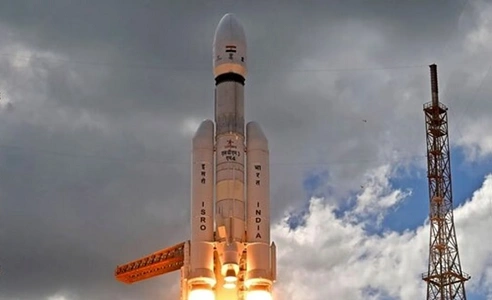
1. Chandrayaan-3 Was a Mission of Redemption
Chandrayaan-3 exists because Chandrayaan-2 almost succeeded. In 2019, the Vikram lander lost communication during its final descent. Instead of calling it a failure, ISRO treated it as a lesson.
Chandrayaan-3 was designed specifically to prove soft-landing capability. There was no orbiter this time, only a lander and a rover. Every weak point from the previous mission was studied, tested, and corrected. In many ways, Chandrayaan-3 was not just a space mission—it was ISRO finishing what it had started.
2. India Landed Near the Moon’s South Pole for the First Time
Most earlier Moon missions landed near the equator, where terrain is smoother and sunlight is predictable. Chandrayaan-3 went much further south, close to the Moon’s south polar region.
This area is scientifically priceless. Deep craters here never receive sunlight and may hold water ice, frozen for billions of years. Water means fuel, oxygen, and life-support possibilities for future missions. By landing here, India opened a new chapter in lunar exploration.
3. Chandrayaan-3 Was Surprisingly Low-Cost
One of the most talked-about aspects of Chandrayaan-3 is its budget. The entire mission cost around ₹615 crore, which is remarkably low by global space standards.
This was possible because ISRO reused existing technology, avoided unnecessary complexity, and focused only on essential goals. The mission proved that cutting-edge space exploration doesn’t always need enormous budgets—smart planning matters more than flashy spending.
4. The Mission Did Not Carry an Orbiter
Unlike Chandrayaan-2, Chandrayaan-3 did not include a new orbiter. Instead, it relied on the existing Chandrayaan-2 orbiter, which is still functioning around the Moon.
This decision saved cost and reduced risk. It also showed excellent long-term planning. The orbiter provided communication support and imaging, while Chandrayaan-3 focused entirely on landing and surface operations.
5. Vikram Lander Had Stronger Safety Systems
The new Vikram lander was built tougher and smarter. ISRO added multiple upgrades:
- Stronger legs to absorb impact
- Better sensors to detect terrain
- Improved software for real-time decision-making
- A wider landing area tolerance
The lander could even abort landing if something went wrong and try again. These changes played a huge role in the smooth touchdown.
6. Pragyan Rover Walked Where No One Had Before
Once Vikram landed safely, the Pragyan rover rolled out onto the lunar surface. Weighing only about 26 kg, this small rover carried powerful instruments.
Pragyan moved slowly, carefully analyzing the soil. It used lasers to identify elements and sent back data confirming the presence of sulphur—a first for the Moon’s surface measurements. Even with limited movement, the rover delivered high-value science.
7. Chandrayaan-3 Studied Moonquakes
One of the lander’s instruments was designed to measure vibrations on the Moon’s surface. These vibrations, called moonquakes, help scientists understand the Moon’s internal structure.
By recording subtle movements, Chandrayaan-3 added valuable data about how the Moon cools, cracks, and changes over time. This information helps researchers compare Earth and Moon geology in deeper ways.
8. The Mission Operated for Just One Lunar Day
Chandrayaan-3 was designed to work for about 14 Earth days, which equals one lunar day. After sunset, temperatures near the south pole drop drastically, and the lander and rover were not built to survive extreme cold.
Despite the short window, ISRO planned the mission so precisely that all major experiments were completed on time. Every hour counted, and none were wasted.
9. India Became a Global Space Leader Overnight
After the successful landing, global attention shifted toward India. Space agencies, scientists, and media worldwide acknowledged the achievement.
India joined an elite group of nations capable of controlled lunar landings. More importantly, it showed leadership in south polar exploration, an area expected to be central to future Moon missions, including human settlements.
10. Chandrayaan-3 Inspired an Entire Generation
Perhaps the most powerful impact of Chandrayaan-3 wasn’t scientific—it was emotional. Students stayed up late to watch the landing. Schools paused classes. Social media filled with pride instead of noise.
The mission showed young minds that science is achievable, meaningful, and exciting. Chandrayaan-3 didn’t just land on the Moon; it landed in the imagination of millions.
Conclusion
Chandrayaan-3 was never about showing off. It was about learning, correcting, and quietly achieving the impossible. With limited resources and clear focus, India reached a place no one else had.
This mission proved that space exploration is not only for the richest nations, but for the most determined ones. And as future missions look toward the Moon’s south pole, they will always remember one thing—India was already there.