 By Hemant Sharma
 Australia often feels like a world of its own. It’s a country, a continent, and an island all at once. Everything about it seems a little extreme—its wildlife, landscapes, weather, and even its sense of humor. Things that feel normal elsewhere behave differently here, from animals to geography.
Australia mixes ancient history with modern life in a way few places do. One moment you’re looking at rock art older than pyramids, the next you’re standing in a city filled with glass towers and beaches. These ten fun facts show why Australia is one of the most surprising places on Earth.
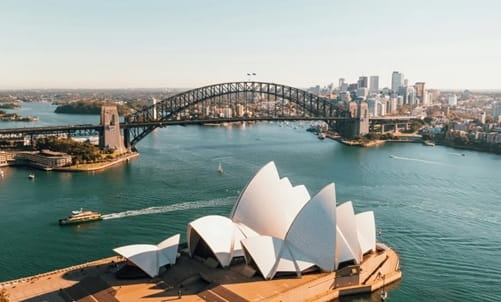
1. Australia Is Both a Country and a Continent
Australia is the only place in the world that is simultaneously a country, a continent, and an island.
Unlike other continents that are made up of many countries, Australia stands alone. This isolation shaped everything—from its ecosystems to its culture. Being cut off from the rest of the world for millions of years allowed life here to evolve in completely unique ways.
That’s why Australia feels so different from anywhere else. It didn’t just develop separately—it developed alone.
2. Most Australians Live Near the Coast
Despite its massive size, most of Australia’s population lives close to the sea.
The interior, known as the Outback, is vast, dry, and sparsely populated. Harsh temperatures and limited water make large-scale settlement difficult. As a result, major cities grew along the coastline where conditions are milder.
This means you can drive for hours inland without seeing towns, but find busy cities hugging the ocean.
3. Australia Has More Kangaroos Than People
One of the most famous fun facts about Australia is actually true.
There are more kangaroos than humans in the country. Kangaroos are incredibly adaptable and thrive across different environments. They are so common that they’re considered a serious road hazard in rural areas.
Seeing a kangaroo isn’t a special event in many places—it’s just part of daily life.
4. The Great Barrier Reef Is Alive—and Huge
Great Barrier Reef is the largest living structure on Earth.
It’s so massive that it can be seen from space. Stretching over 2,300 kilometers, the reef is home to thousands of species of fish, coral, and marine life. What makes it even more fascinating is that it’s alive—built by tiny coral organisms over thousands of years.
It’s not just a natural wonder; it’s a living ecosystem constantly growing, changing, and struggling to survive.
5. Australia Has Some of the Oldest Cultures on Earth
Aboriginal Australian cultures are among the oldest continuous cultures in human history.
They date back more than 60,000 years. Long before modern cities existed, Indigenous Australians had complex knowledge systems involving astronomy, medicine, land management, and storytelling.
Sacred sites, rock art, and oral traditions still survive today, making Australia a place where ancient and modern worlds coexist.
6. Australia Has Snow, Deserts, and Rainforests
Many people imagine Australia as hot and dry everywhere. That’s not true.
Australia has snowy mountains, tropical rainforests, long beaches, wetlands, and massive deserts. Some regions receive heavy rainfall, while others go years with very little water.
In winter, parts of Australia even have ski resorts. The country doesn’t have one climate—it has many.
7. The World’s Deadliest Animals Live Here
Australia is famous for dangerous wildlife, and the reputation isn’t completely exaggerated.
Some of the world’s most venomous snakes, spiders, jellyfish, and marine creatures are found here. But interestingly, animal attacks are rare. Australians have learned how to live alongside this wildlife with awareness and respect.
The animals aren’t aggressive by nature—they just evolved with powerful defenses.
8. Australians Love Shortening Words
Australian English has a playful habit of shortening almost everything.
Afternoon becomes “arvo,” breakfast becomes “brekkie,” mosquito becomes “mozzie,” and sunglasses are “sunnies.” This casual language reflects the relaxed and friendly communication style common across the country.
It can be confusing at first, but once you get used to it, it’s part of the charm.
9. Uluru Changes Color Throughout the Day
Uluru is one of Australia’s most iconic natural landmarks.
What makes it truly special is how it changes color depending on sunlight and weather. At sunrise and sunset, Uluru can glow red, orange, purple, and even deep brown.
For Indigenous Australians, Uluru is not just a rock—it’s a sacred site filled with spiritual meaning and ancestral stories.
10. Australia Once Lost a War to Birds
This sounds like a joke, but it actually happened.
In the 1930s, Australia attempted to control emu populations using soldiers and machine guns. The emus proved too fast, too spread out, and too resilient. The mission failed and became known as the “Emu War.”
The birds survived. The humans retreated. It remains one of history’s most unusual military stories.
Conclusion
Australia is not just a destination—it’s an experience that constantly challenges expectations. It’s ancient yet modern, dangerous yet welcoming, isolated yet globally connected. Its landscapes stretch endlessly, its wildlife behaves differently, and its cultures run deeper than most people realize.
The more you learn about Australia, the more you understand why it feels so unique. It’s not just another country on the map. It’s a place shaped by time, distance, and nature doing things its own way.