 By Hemant Sharma
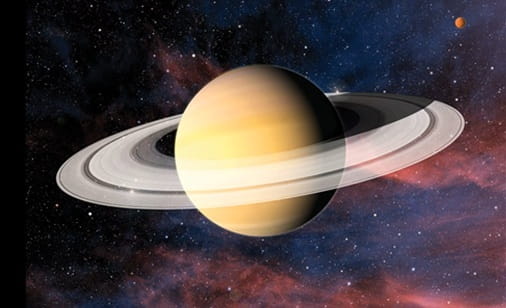
 Saturn looks calm, distant, and almost artistic when seen from space. Its smooth rings and soft golden color make it appear peaceful, even gentle. But beneath that beauty lies a planet of extremes—violent storms, crushing pressure, freezing temperatures, and forces so powerful they bend matter itself. Saturn is not silent because it is simple. It is silent because it is ancient, massive, and still full of mysteries.
Studying Saturn teaches us an important lesson about the universe: things are rarely what they seem at first glance. Strength can look elegant. Danger can look beautiful. Time can move slowly yet change everything. With that perspective in mind, let’s check out the top 10 interesting facts about Saturn and understand why this planet continues to fascinate scientists and sky-watchers alike.
1. Saturn Is the Least Dense Planet in the Solar System
Saturn is enormous, second only to Jupiter in size, yet it is surprisingly light for its volume. It is the least dense planet in the solar system.
In theory, if there were a bathtub large enough, Saturn could float in water. This strange fact comes from its composition. Saturn is made mostly of hydrogen and helium, the lightest elements in the universe. It reminds us that size does not always equal solidity.
2. Saturn Is Mostly Gas and Has No Solid Surface
Unlike Earth, Saturn does not have a solid surface you could stand on. As you move deeper into the planet, gas gradually becomes thicker until it behaves like liquid.
There is no clear line where sky ends and ground begins. Pressure increases so intensely that atoms are forced into unusual states. Saturn exists in layers, not land. It challenges our basic idea of what a “planet” should be.
3. Saturn’s Rings Are Made of Countless Pieces
Saturn’s rings may look like smooth bands, but they are actually made of billions of individual pieces of ice and rock.
Some particles are as small as dust grains, while others are as large as houses. Each piece orbits Saturn independently, held together only by gravity. The rings are wide but extremely thin, showing how something delicate can appear massive from afar.
4. The Rings Will Not Last Forever
One of the most surprising discoveries about Saturn is that its rings are slowly disappearing.
Gravity and solar radiation are pulling ring material down into the planet in a process scientists call “ring rain.” Over hundreds of millions of years, the rings may fade completely. Saturn teaches a quiet truth here: even the most iconic beauty in the universe is temporary.
5. A Day on Saturn Is Very Short
Saturn spins extremely fast. One full day on Saturn lasts only about 10.7 hours.
This rapid rotation causes the planet to bulge at the equator and flatten at the poles. Saturn is visibly squashed because of speed alone. Motion shapes its form, showing how movement can define identity even on a planetary scale.
6. Saturn Has the Most Moons in the Solar System
Saturn currently holds the record for the highest number of moons orbiting a planet. Each moon is different, with its own story and environment.
Some moons are icy and reflective. Others are rocky and dark. Titan, the largest moon, has rivers and lakes—not of water, but of liquid methane. Enceladus sprays water into space, hinting at hidden oceans beneath ice. Saturn is not just one world, but a system of many.
7. Saturn’s Winds Are Incredibly Powerful
Beneath its calm appearance, Saturn is a world of violent weather. Winds on Saturn can exceed 1,800 kilometers per hour, far stronger than any hurricane on Earth.
Storms can last for years. One of the most mysterious features is the hexagon-shaped storm at Saturn’s north pole—a perfectly shaped, long-lasting weather pattern that scientists still cannot fully explain. Order exists even within chaos.
8. Saturn Is Extremely Cold
Because Saturn is far from the Sun, it receives much less heat than Earth. Temperatures can drop to around −178°C.
At such cold levels, normal chemistry changes. Gases freeze, and materials behave differently. While Saturn itself cannot support life as we know it, its moons may hold conditions that help scientists understand where life could exist elsewhere in the universe.
9. Saturn’s Gravity Controls Everything Around It
Saturn’s gravity is immense. It shapes the motion of its rings, moons, and even space debris nearby.
Nothing around Saturn moves freely. Everything is influenced, guided, or trapped by its gravitational pull. Gravity is invisible, but its power is absolute. Like unseen forces in life, it shapes outcomes whether we notice it or not.
10. Saturn Helps Scientists Understand the Origin of the Solar System
Saturn acts like a time capsule from the early days of the solar system. Its composition preserves clues about how planets formed billions of years ago.
By studying Saturn, scientists learn not just about one planet, but about the birth of planetary systems everywhere. Saturn helps us understand Earth’s past—and possibly humanity’s future among the stars.
Conclusion
Saturn is a planet of contrasts. It is massive yet light, beautiful yet dangerous, ancient yet slowly changing. Its rings shine brightly, even as they fade. Its storms rage silently, unseen from Earth.
Looking at Saturn is more than an astronomical experience. It is a reminder that strength can be subtle, beauty can be temporary, and time always leaves its mark. In its quiet orbit, Saturn teaches us to look deeper than appearances—and to respect the powerful forces shaping the universe around us.