 By Hemant Sharma
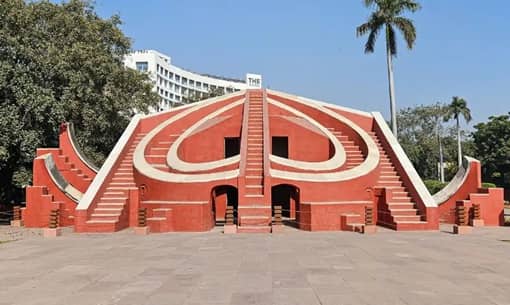
 Jantar Mantar is one of the most unusual historical sites in Delhi. At first glance, it looks like a collection of giant stone sculptures placed randomly on the ground. But in reality, every structure here has a scientific purpose.
Built in the early 18th century, Jantar Mantar represents a time when astronomy was studied with the naked eye, mathematics, and carefully designed instruments—long before modern telescopes and computers. It stands today as a reminder that science and architecture once moved hand in hand.
1. Jantar Mantar Was Built by Maharaja Jai Singh II
Jantar Mantar was built by Maharaja Jai Singh II of Jaipur, a ruler deeply interested in astronomy and mathematics. He constructed several observatories across India, and the one in Delhi is among the most important.
His goal was to improve the accuracy of astronomical observations used for calendars, astrology, and timekeeping.
2. It Was Constructed in 1724
The Delhi Jantar Mantar was built in 1724, during the Mughal period. At that time, scientific observation depended entirely on manual instruments.
Despite its age, many of its calculations were remarkably precise, showing how advanced Indian astronomy had become by the 18th century.
3. The Instruments Are Made of Stone and Marble
Unlike modern metal instruments, the tools at Jantar Mantar are built using stone, brick, and marble. This made them stable and resistant to weather changes.
The massive size of the instruments reduced errors caused by human observation, increasing accuracy.
4. Samrat Yantra Is the Largest Instrument
The Samrat Yantra is the most prominent structure at Jantar Mantar. It is essentially a giant sundial used to measure time.
On a clear day, it can measure time with an accuracy of about two seconds, which is impressive even by modern standards.
5. Jantar Mantar Was Used to Track Celestial Bodies
Astronomers used this site to observe the Sun, Moon, and planets. The instruments helped calculate eclipses, planetary movements, and seasonal changes.
These observations were essential for preparing calendars and predicting astronomical events.
6. It Is One of Five Jantar Mantars in India
Delhi’s Jantar Mantar is not the only one. Jai Singh II built five observatories across India—in Jaipur, Delhi, Ujjain, Mathura, and Varanasi.
Among them, Jaipur’s Jantar Mantar is the largest and best preserved.
7. The Name “Jantar Mantar” Comes From Sanskrit
The term “Jantar Mantar” is derived from Sanskrit words meaning “instrument” and “formula.” Over time, the pronunciation evolved into its present form.
The name reflects the scientific purpose of the site rather than its architectural beauty.
8. It Is Located in the Heart of Modern Delhi
Jantar Mantar sits right next to Connaught Place, one of Delhi’s busiest commercial areas.
This contrast—ancient science surrounded by modern city life—makes the site even more striking. It feels like stepping back in time within minutes.
9. It Is a Protected National Monument
Jantar Mantar is maintained by the Archaeological Survey of India (ASI) and is protected as a national heritage site.
Restoration work has been carried out to preserve its instruments and prevent further damage from pollution and weather.
10. It Shows India’s Early Scientific Thinking
More than a tourist attraction, Jantar Mantar represents India’s long tradition of scientific inquiry.
It proves that astronomy in India was not based only on belief or astrology, but on observation, calculation, and experimentation.
Conclusion
Jantar Mantar is not just an old structure—it is a stone textbook of astronomy. It shows how people once measured time, tracked planets, and understood the universe using pure logic and design.
In the middle of a fast-moving city, Jantar Mantar stands still, reminding us that curiosity about the sky has always been part of human history.