 By Hemant Sharma
 India does not need a special season to look beautiful, but flowering trees make the country feel magical. One road suddenly turns golden with Amaltas. Another looks like it is burning with Gulmohar flowers. In spring, Palash paints dry forests orange, while Semal drops large red blooms like nature’s own carpet. These trees do more than decorate streets and gardens. They give shade, attract birds and butterflies, support local biodiversity, and bring colour to cities that often look grey and crowded.
Flowering trees are perfect for parks, schools, farmhouses, temple areas, large home gardens, public roads, and urban landscapes. Some are native to India, while a few are exotic trees that have become very common in Indian cities. Here are the top 10 flowering trees in India that are loved for their beauty, shade, fragrance, cultural value, and seasonal charm.
1. Gulmohar
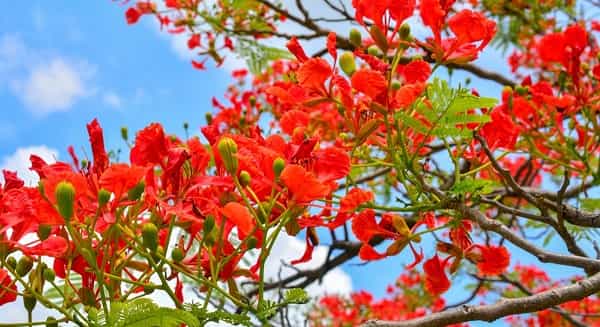
Gulmohar is one of the most dramatic flowering trees seen in India. During summer, its wide canopy gets covered with bright red-orange flowers, making the tree look like a flame in the sky. That is why it is also called the Flame Tree or Royal Poinciana.
It is commonly planted along roads, in parks, school campuses, colonies, and large gardens. Gulmohar gives excellent shade because of its umbrella-like canopy. Its fern-like leaves also add a soft, graceful look even when the tree is not in bloom. The tree is widely grown as an ornamental avenue tree in tropical regions, and its summer flowering makes it one of the most recognisable trees in Indian cities.
Flowering season: April to June
Best for: Roadsides, parks, large gardens, campuses
2. Amaltas
Amaltas, also known as Indian Laburnum or Golden Shower Tree, is one of the most loved flowering trees in India. When it blooms, long yellow flower bunches hang from the branches like golden chains. It is especially beautiful in hot summer when many other trees look dry and dull.
Amaltas is native to the Indian subcontinent and is also the state flower of Kerala and Delhi. It blooms mainly in late spring and early summer, often covering the tree with yellow flowers when there are very few leaves visible. It is drought-tolerant and suitable for Indian heat, making it a strong choice for urban landscaping.
Flowering season: April to June
Best for: Streets, gardens, parks, dry regions
3. Jacaranda
Jacaranda, also called Neel Mohar in many places, is famous for its blue-purple flowers. When the tree blooms, the whole area around it can look like a soft violet carpet. It brings a peaceful and slightly foreign charm to Indian gardens and hill cities.
Jacaranda is originally from South America but has been widely planted in India because of its beautiful flowers and elegant leaves. It grows well in warm climates and is often seen in cities, cantonment areas, botanical gardens, and old colonial-style avenues. Flowers of India notes that Jacaranda trees become impressive in May when covered with clusters of blue tubular flowers.
Flowering season: March to May
Best for: Avenues, gardens, hill towns, institutional campuses
4. Champa
Champa is one of the most fragrant flowering trees in India. Its creamy yellow-orange flowers are small compared to Gulmohar or Amaltas, but their fragrance is rich, deep, and unforgettable. The flowers are used in worship, perfumes, and traditional decoration.
Magnolia champaca, earlier known as Michelia champaca, is a large evergreen tree known for its fragrant flowers. Flowers of India describes Champa as a well-known flower native to India and popular for its fragrance. It is a beautiful choice for temples, old gardens, spiritual spaces, and large homes where fragrance matters as much as colour.
Flowering season: Mainly spring to monsoon, depending on region
Best for: Temples, gardens, fragrance gardens, large homes
5. Kachnar
Kachnar is a graceful flowering tree with orchid-like flowers. Its blooms come in shades of pink, purple, white, and lavender, giving it a soft and elegant appearance. The leaves are also attractive because they look like a camel’s hoof or butterfly wings.
Kachnar is common in many parts of India and is valued both for beauty and usefulness. Its flower buds are used in Indian cooking in some regions, especially in traditional dishes and pickles. Flowers of India describes Kachnar, or Orchid Tree, as “staggeringly beautiful when in bloom” and notes that it flowers for several months.
Flowering season: February to April
Best for: Gardens, parks, streets, traditional landscapes
6. Palash
Palash is one of India’s most culturally powerful flowering trees. It is also called Flame of the Forest, and the name is perfect. In spring, when many leaves fall, the tree bursts into bright orange-red flowers. Dry forests suddenly look alive because of Palash.
It is strongly connected with Holi, Indian folk culture, Ayurveda, and village landscapes. The flowers were traditionally used to make natural colours. Palash grows well in dry and tough conditions, which makes it important for rural and forest areas. It is native to India and tropical South Asia, and its vivid flowers are highly prized for their beauty.
Flowering season: February to April
Best for: Dry landscapes, forest edges, rural areas, eco-parks
7. Semal
Semal, also known as Silk Cotton Tree, is a tall and majestic flowering tree. It produces large red flowers, usually before the new leaves appear. When these flowers fall, the ground looks decorated with red cups. Birds love Semal flowers because they are rich in nectar.
This tree is common in many parts of India, especially in open spaces, forests, parks, and old village areas. Its trunk often has thorns when young, and its fruits produce cotton-like fibre. Flowers of India notes that Semal bears beautiful red flowers during January to March, painting the landscape in a red hue.
Flowering season: January to March
Best for: Large spaces, parks, forests, biodiversity planting
8. Jarul
Jarul, also called Pride of India or Queen’s Crape Myrtle, is one of the finest purple flowering trees in India. Its flowers look like delicate crinkled paper and appear in shades of pink, lilac, and purple. When planted in rows, Jarul can make roads and parks look extremely elegant.
It is native to tropical South and Southeast Asia and is recognised as the state flower of Maharashtra. The tree bears attractive flowers in profusion, and the bloom can last for many months in suitable conditions. Jarul also has a handsome trunk and good canopy, making it a complete ornamental tree.
Flowering season: April to July
Best for: Avenues, parks, public gardens, campuses
9. Indian Cork Tree
Indian Cork Tree is a tall, straight, elegant flowering tree often planted in gardens and avenues. Its white tubular flowers are fragrant and usually bloom in clusters. At night and early morning, fallen flowers under the tree create a lovely white carpet.
Millingtonia hortensis is widely cultivated in India for ornamental value. Flowers of India describes it as a fine, fast-growing tree that is cultivated in most parts of India in gardens and avenues. It can grow tall in favourable locations, though its wood is brittle and can be damaged by storms.
Flowering season: September to December
Best for: Avenues, gardens, colonies, large compounds
10. Frangipani
Frangipani, commonly called Plumeria or Temple Tree, is one of the most familiar flowering trees around Indian temples and homes. Its flowers are thick, waxy, fragrant, and available in white, yellow, pink, red, and mixed shades. Even a small Frangipani tree can look beautiful when it blooms.
Though originally native to the Americas, Plumeria has become deeply connected with Indian temple landscapes and garden culture. It grows well in warm climates, tolerates dry spells, and does not need too much care after establishment. Its sculptural branches make it attractive even when leafless.
Flowering season: Summer to autumn
Best for: Temples, home gardens, courtyards, dry warm regions
Other Beautiful Flowering Trees Worth Mentioning
India has many more flowering trees that deserve attention. Copperpod gives bright yellow blooms and looks beautiful beside Gulmohar. Parijat is loved for its fragrant white-orange flowers. Indian Coral Tree has striking red blooms. Rain Tree produces soft pinkish flowers and gives a huge canopy. Bottlebrush is also popular in gardens because of its red brush-like flowers.
Conclusion
Flowering trees make India’s cities, villages, roads, and gardens more alive. They bring colour, fragrance, shade, birds, and seasonal joy. Planting even one right flowering tree can turn an ordinary space into something memorable for years.