 By Hemant Sharma
 Choosing the correct vehicle coverage is a fundamental responsibility for every motorist. Navigating the terminology can be complex, particularly when distinguishing between the various tiers of protection available.
The decision primarily rests between two distinct options: 1st party car insurance and third-party liability coverage. Each serves a specific purpose, carries different legal implications, and offers varying degrees of financial security.
Understanding these differences ensures that motorists can safeguard their assets effectively while remaining compliant with statutory requirements.
This blog provides a comprehensive evaluation of both options to assist drivers in making an informed selection for their vehicular protection.
The Structural Breakdown of Coverages
To appreciate the differences between these two insurance categories, one must first examine what each policy fundamentally intends to protect.
- Coverage Scope and Financial Protection
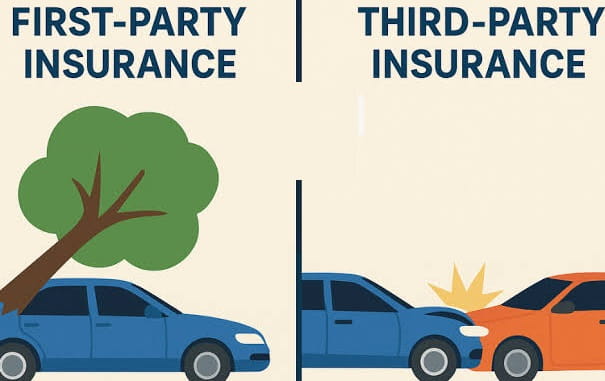
The primary distinction is in the breadth of protection provided by the policy. A third-party insurance policy provides limited coverage, protecting you only against legal and financial liabilities for injuries or damage caused to another person, their vehicle, or their property. It offers no financial relief for the policyholder’s own losses.
Conversely, 1st party car insurance offers a dual layer of protection. It addresses those mandatory third-party liabilities and simultaneously covers the costs to repair or replace the policyholder’s own vehicle following an accident, theft, or natural calamity.
- Legal Obligations and Regulatory Compliance
The two types of coverages operate under entirely different regulatory mandates. Under the Motor Vehicles Act, maintaining third-party insurance is a strict legal requirement for any vehicle operating on public roads. Driving without this minimum level of protection is a punishable offence.
On the other hand, investing in 1st party car insurance is entirely optional from a legal standpoint. While the law does not compel a vehicle owner to purchase it, the extensive financial security it provides makes it highly recommended by financial experts and risk advisors.
Analysing the Core Operational Parameters
Evaluating specific features side by side highlights how these policies diverge in daily application, cost structures, and claims settlement.
| Comparison Factor | First-Party Insurance (Comprehensive/Own Damage) | Third-Party Insurance (Act-Only Cover) |
| Purpose of the Policy | Protects your own vehicle against insured damage (theft, accidents, natural disasters) while also covering third-party liabilities. | Focuses strictly on compensating losses, damages, or bodily injuries suffered by another person or their property. |
| Compliance Requirement | Optional/Voluntary, purchased to enhance financial protection for your own assets. | Mandatory by law under the Motor Vehicles Act, before a vehicle can be driven on public roads. |
| Pricing Structure | It varies based on Insured Declared Value (IDV), vehicle age, make/model, RTO location, and chosen add-ons. | It is determined annually by regulatory authorities (like IRDAI in India) based on engine cubic capacity (cc) slabs. |
| Recipient of Claim | Claim payments are made to you (the insured vehicle owner) or directly to the network garage. | Claim compensation is paid directly to the affected third party (upon a ruling by the Motor Accident Claims Tribunal). |
| Add-on Customization | Highly customizable with add-ons like Zero Depreciation, Engine Protection, and Roadside Assistance. | No add-on covers can be attached to a standalone third-party policy. |
Premium Costs and Pricing Drivers
The financial investment required for each policy reflects the level of risk the underwriter assumes. Third-party insurance features a lower premium, which is strictly regulated and fixed by the Insurance Regulatory and Development Authority of India (IRDAI). These rates are determined systematically based on the engine capacity of the vehicle.
In contrast, the premium for 1st party car insurance is significantly higher. This increased cost is directly proportional to the expansive financial shield it provides. The pricing for this tier is not fixed by the regulator; instead, insurers calculate it using factors such as the IDV of the vehicle, the age of the car, the geographical location, and the historical claim record of the driver.
Payout Beneficiary Structure
The destination of the funds during a claims process marks another absolute difference between the frameworks. In a third-party scenario, the policyholder never receives a financial payout. The funds are directed entirely to the affected third party who suffered the injury or property damage.
When utilising 1st party car insurance, the beneficiary structure changes. When the policyholder’s vehicle incurs damage, the insurance company reimburses the policyholder directly or pays the authorised garage to cover the repair expenses. The vehicle owner is the direct recipient of the financial assistance.
Strategic Considerations for Motorists
Selecting the appropriate framework requires an objective assessment of risk, vehicle value, and personal financial capacity.
- Asset Protection: Owners of new, expensive, or moderately priced vehicles generally require the protection of an own-damage policy to avoid catastrophic financial losses from repair bills.
- Regulatory Compliance: Motorists who prioritise basic legal compliance over vehicle protection often select the third-party option, accepting the reality that they must self-fund any repairs to their own transport.
- Risk Mitigation: The comprehensive nature of a first-party framework mitigates unforeseen expenses stemming from vandalism, environmental hazards, or accidents where fault cannot be easily established.
Ultimately, the choice dictates how much financial vulnerability a motorist is willing to accept. While the third-party option satisfies the baseline legal threshold, it leaves the owner entirely responsible for their own vehicular assets during an unfortunate incident.
Protect Your Vehicle with the Right Insurance Cover
Securing the appropriate vehicular protection requires a clear alignment between regulatory mandates and personal financial safety. Third-party insurance ensures legal compliance on public roads, yet it leaves the vehicle owner vulnerable to out-of-pocket repair costs.
For those seeking expert guidance, competitive options, and clear policy comparisons, evaluating the market with a trusted partner is highly advantageous. Protect your vehicular investments responsibly by exploring the insurance solutions accessible through online insurance brokers like Jio Insurance Broking Ltd.
A well-chosen insurance policy safeguards your vehicle and offers greater financial confidence every time you take to the road.