 By Hemant Sharma
 A nuclear power plant does not look dramatic from outside like a giant dam or a smoking thermal plant. It works quietly, with strict safety systems, heavy engineering, scientific precision and round-the-clock monitoring. Yet, inside those protected complexes, a small amount of nuclear fuel produces a huge amount of electricity without the direct carbon emissions of coal-based power.
In 2026, nuclear energy has become more important for India’s long-term power security. Solar and wind are growing fast, but India also needs stable base-load electricity that can run day and night. According to a March 2026 PIB update, India’s present installed nuclear power capacity is 8,780 MW, from 24 nuclear power plants, excluding RAPS-1. The same update says 18 reactors with 13,600 MW capacity are under implementation, including under-construction and pre-project reactors.
Here are the top 10 major nuclear power plants and projects in India in 2026, based on capacity, importance and future role.
1. Kudankulam Nuclear Power Plant, Tamil Nadu
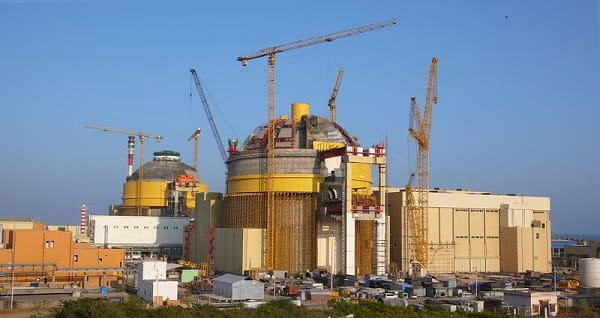
Kudankulam Nuclear Power Plant in Tirunelveli district of Tamil Nadu is India’s largest operating nuclear power station. It currently has two operating VVER pressurised water reactors of 1,000 MW each, giving it an installed operating capacity of 2,000 MW.
The plant has been developed with Russian cooperation and is one of India’s most important nuclear energy assets. Kudankulam is also India’s biggest nuclear expansion site because Units 3 and 4, and Units 5 and 6, are under construction, each pair adding 2 x 1,000 MW capacity. Once all six units are completed, Kudankulam will become a 6,000 MW nuclear complex, making it one of the strongest clean energy hubs in the country.
Capacity in operation: 2,000 MW
State: Tamil Nadu
Reactor type: VVER / PWR
2. Kakrapar Atomic Power Station, Gujarat
Kakrapar Atomic Power Station in Gujarat is one of India’s most important indigenous nuclear power success stories. It has two older 220 MW PHWR units and two newer 700 MW PHWR units. NPCIL lists Kakrapar Units 1 and 2 at 220 MW each, Unit 3 at 700 MW, and Unit 4 at 700 MW, taking total installed capacity to 1,840 MW.
The biggest importance of Kakrapar is that its 700 MW PHWR units represent India’s modern domestic reactor design. These reactors are central to India’s future nuclear expansion plan. Kakrapar is not just a plant; it is a model for India’s self-reliant nuclear technology.
Capacity: 1,840 MW
State: Gujarat
Reactor type: PHWR
3. Rajasthan Atomic Power Station, Rawatbhata
Rajasthan Atomic Power Station at Rawatbhata is one of India’s oldest and largest nuclear power centres. It has played a major role in India’s nuclear journey for decades. NPCIL’s current operating list includes RAPS Unit 2 of 200 MW, Units 3 to 6 of 220 MW each, and RAPS Unit 7 of 700 MW, which achieved commercial operation on April 15, 2025.
This gives the currently listed operating NPCIL capacity at Rawatbhata as 1,780 MW, excluding the old RAPS-1 unit. RAPP-8, another 700 MW PHWR, is also listed under projects under construction/commissioning. Because of its size, long operating history and expansion, Rawatbhata remains one of India’s most important nuclear locations.
Capacity in operation: Around 1,780 MW
State: Rajasthan
Reactor type: PHWR
4. Tarapur Atomic Power Station, Maharashtra
Tarapur Atomic Power Station is historic because it was India’s first commercial nuclear power station. Located in Maharashtra, it has two older BWR units of 160 MW each and two PHWR units of 540 MW each, making its total installed capacity 1,400 MW.
Tarapur has a special place in India’s energy history. It represents both the early phase and later expansion of India’s nuclear programme. Even after many decades, it remains one of the country’s major nuclear stations and supplies clean base-load power to the western grid.
Capacity: 1,400 MW
State: Maharashtra
Reactor type: BWR and PHWR
5. Kaiga Generating Station, Karnataka
Kaiga Generating Station is a major nuclear power station in Karnataka. It has four PHWR units of 220 MW each, giving it an operating capacity of 880 MW. The station is located in the Western Ghats region and is known for stable operations and strong safety practices.
Kaiga is also important for the future because Kaiga Units 5 and 6, each of 700 MW, are listed among India’s under-construction nuclear projects. Once these new units are completed, Kaiga’s role in India’s nuclear power map will become much bigger.
Capacity in operation: 880 MW
State: Karnataka
Reactor type: PHWR
6. Gorakhpur Haryana Anu Vidyut Pariyojana, Haryana
Gorakhpur Haryana Anu Vidyut Pariyojana, also known as GHAVP, is one of the most important upcoming nuclear power projects in north India. It is being developed in Fatehabad district of Haryana. The first phase, GHAVP Units 1 and 2, has 2 x 700 MW PHWR units under construction.
This project is important because Haryana does not have the same long nuclear history as Maharashtra, Rajasthan or Tamil Nadu. GHAVP will help expand India’s nuclear power footprint into a new region and support the power demand of northern India.
Planned capacity, Phase 1: 1,400 MW
State: Haryana
Status: Under construction
7. Madras Atomic Power Station and Kalpakkam Nuclear Complex, Tamil Nadu
Kalpakkam is one of India’s most important nuclear centres because it has both an operating atomic power station and advanced nuclear research facilities. Madras Atomic Power Station has two PHWR units of 220 MW each, giving it 440 MW capacity.
Kalpakkam is also home to the 500 MW Prototype Fast Breeder Reactor, which PIB described in 2026 as being under commissioning by BHAVINI. This makes Kalpakkam strategically important beyond its present generation capacity. It is linked with India’s long-term fast breeder and thorium-based nuclear ambitions.
Operating capacity: 440 MW
State: Tamil Nadu
Special importance: Fast breeder reactor programme
8. Narora Atomic Power Station, Uttar Pradesh
Narora Atomic Power Station is one of north India’s key nuclear power stations. Located in Uttar Pradesh, it has two PHWR units of 220 MW each, giving it a total capacity of 440 MW.
Narora may not be the largest plant by capacity, but it is very important because of its location in the northern power network. It also has a long operating history and remains a key part of India’s indigenous PHWR fleet.
Capacity: 440 MW
State: Uttar Pradesh
Reactor type: PHWR
9. Mahi Banswara Rajasthan Atomic Power Project, Rajasthan
Mahi Banswara is one of the biggest upcoming nuclear power projects planned in India. PIB’s 2026 update lists Mahi Banswara Units 1 and 2 and Units 3 and 4 under pre-project activities, each pair having 2 x 700 MW capacity. Together, the proposed project adds up to 2,800 MW.
This project will strengthen Rajasthan’s position as one of India’s most important nuclear power states. Since Rajasthan already hosts Rawatbhata, Mahi Banswara will add another major nuclear hub in the state if developed as planned.
Planned capacity: 2,800 MW
State: Rajasthan
Status: Pre-project activities
10. Chutka Madhya Pradesh Atomic Power Project, Madhya Pradesh
Chutka Madhya Pradesh Atomic Power Project is another important upcoming nuclear project. NPCIL lists Chutka as a new project site with 2 x 700 MW PHWR units. PIB’s 2026 update also includes Chutka Units 1 and 2 under pre-project activities with 1,400 MW planned capacity.
The project is important because it will expand nuclear power development into Madhya Pradesh. It can support central India’s power needs and contribute to India’s long-term clean energy target.
Planned capacity: 1,400 MW
State: Madhya Pradesh
Status: Pre-project activities
Conclusion
India’s nuclear power sector is moving from a small base to a larger clean-energy role. Kudankulam, Kakrapar, Rawatbhata, Tarapur and Kaiga are already major power centres, while Gorakhpur, Mahi Banswara and Chutka show where the future is heading. Nuclear energy may not grow as fast as solar, but it will remain important for stable, round-the-clock electricity.