 By Hemant Sharma
 Roaches are among the most disliked creatures on Earth. Just the sight of one can cause panic, disgust, or instant action. Yet, behind that reaction lies one of the most successful survival stories in nature. Roaches are not weak pests—they are ancient, intelligent survivors that have outlived dinosaurs, ice ages, and massive environmental changes.
They thrive in conditions where many organisms fail. They adapt quickly, hide cleverly, and endure extremes that seem impossible. Whether you like them or not, roaches are biological marvels. These ten facts reveal why roaches are far more extraordinary than their reputation suggests.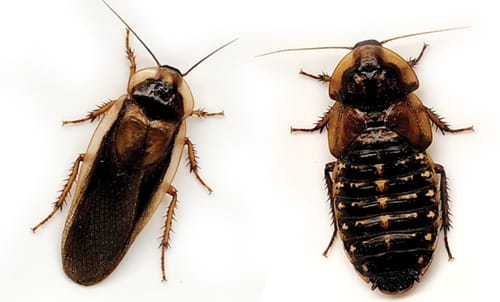
1. Roaches Are Older Than Dinosaurs
Roaches have existed for over 300 million years.
They were crawling on Earth long before dinosaurs appeared and survived every major mass extinction. While countless species vanished, roaches adapted and endured.
Their basic body design changed very little over millions of years, which tells scientists one thing clearly: evolution got it right early. Roaches didn’t need to become fancy to survive—they needed to be efficient.
2. Roaches Can Live Without a Head
One of the most shocking facts about roaches is that they can survive without their head.
A decapitated roach can live for several days to weeks. This is possible because roaches breathe through small openings along their body, not through their mouth or head. Their basic nerve functions are also spread throughout the body.
Eventually, the roach dies—not from injury, but from dehydration or starvation. It’s disturbing, but biologically fascinating.
3. Roaches Can Survive Without Food for a Month
Roaches are extremely energy-efficient.
They can live up to 30 days without food and about a week without water. Their slow metabolism allows them to conserve energy and survive long periods of scarcity.
This ability makes them incredibly difficult to eliminate. Even when food sources disappear, roaches wait patiently until conditions improve.
4. Roaches Are Extremely Fast
For their size, roaches are lightning-fast.
Some species can run at speeds equivalent to a human running over 300 km/h when scaled to body size. This speed helps them escape predators and humans instantly.
Their sudden movement isn’t random panic—it’s a well-tuned survival response triggered by air movement, vibrations, and light changes.
5. Roaches Can Flatten Their Bodies to Escape
Roaches have flexible exoskeletons.
They can squeeze into cracks as thin as a few millimeters by flattening their bodies. This allows them to hide in walls, under floors, inside appliances, and behind furniture.
This ability explains why roaches are so hard to locate and why sealing small gaps is crucial in pest control.
6. Roaches Are Mostly Nocturnal
Roaches prefer darkness.
They are primarily nocturnal creatures, which means they come out at night to search for food and water. If you see roaches during the day, it often indicates a large infestation or lack of hiding space.
Their dislike for light is a survival trait that helps them avoid predators and human detection.
7. Roaches Can Eat Almost Anything
Roaches are true omnivores.
They can eat food scraps, paper, glue, soap, hair, fabric, cardboard, and even dead insects. Some species can digest materials that are useless to most animals.
This extreme dietary flexibility allows roaches to survive in environments where other species would starve.
8. Roaches Can Hold Their Breath for Long Periods
Roaches can hold their breath for up to 40 minutes.
They do this to conserve water and survive underwater or in low-oxygen environments. This ability makes drowning them ineffective and allows them to survive in drains and damp areas.
Their breathing system is designed for endurance, not speed—another reason they survive so well.
9. Roaches Are Highly Resistant to Radiation
Roaches can tolerate radiation levels far higher than humans.
While they are not completely immune, their cells divide more slowly than human cells, making them less vulnerable to radiation damage.
This is why roaches are often mentioned in post-apocalyptic scenarios. Their biology gives them a clear advantage in extreme conditions.
10. Roaches Are Important to Ecosystems
Despite their bad reputation, roaches play a role in nature.
In the wild, they help decompose organic matter, recycle nutrients, and enrich soil. They also serve as food for birds, reptiles, and small mammals.
Problems arise mainly when roaches move into human spaces. In natural ecosystems, they are not pests—they are cleaners.
Conclusion
Roaches are not just household nuisances. They are among the toughest survivors the planet has ever produced. Their resilience, adaptability, and efficiency are the result of millions of years of evolution fine-tuning every detail.
You don’t have to like roaches to respect them. They remind us that survival doesn’t depend on beauty or popularity—it depends on adaptability. In a world that constantly changes, roaches prove one uncomfortable truth: the strongest survivors are often the ones we underestimate the most.