 By Hemant Sharma
 Crocodiles look like they belong to another age—and in many ways, they do. These creatures were roaming rivers and swamps when dinosaurs ruled the Earth. While countless species vanished over millions of years, crocodiles barely changed. They adapted, endured, and survived almost everything nature threw at them.
Today, crocodiles are often feared, sometimes misunderstood, and rarely appreciated for how remarkable they truly are. Beneath their armored skin and terrifying jaws lies a creature perfectly engineered for survival. These ten fun facts reveal why crocodiles are not just dangerous predators, but some of the most fascinating animals on the planet.
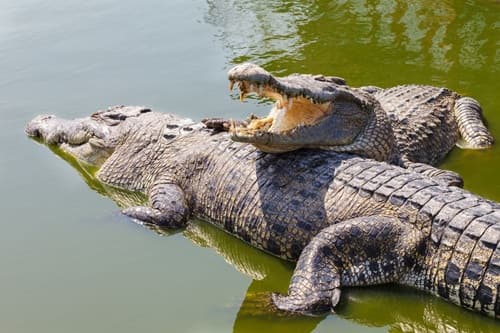
1. Crocodiles Are Living Fossils
Crocodiles have existed for over 200 million years.
That means they lived alongside dinosaurs—and survived the mass extinction that wiped most of them out. What makes this impressive is that crocodiles didn’t survive by chance. Their body design was already close to perfect.
Their slow metabolism, powerful bite, semi-aquatic lifestyle, and adaptability allowed them to thrive while other species disappeared. When you look at a crocodile today, you’re essentially looking at ancient history still alive.
2. Crocodiles Have the Strongest Bite Ever Measured
Among all living animals, crocodiles have the strongest bite force.
A large adult crocodile can bite with a force of over 3,700 pounds per square inch. That’s strong enough to crush bone, shells, and even metal objects in some cases.
What’s interesting is that while their bite is incredibly powerful when closing, the muscles used to open their jaws are quite weak. In theory, a human could hold a crocodile’s mouth shut using their hands—though trying that would be a very bad idea.
3. Crocodiles Can Live a Very Long Time
Crocodiles are known for their long lifespan.
Many species can live 70 to 100 years, and some may live even longer in the wild. Scientists believe their slow metabolism plays a major role in this longevity. They burn energy slowly and can survive long periods without food.
In some cultures, crocodiles are seen as symbols of endurance and timelessness—and biology strongly supports that idea.
4. Crocodiles Can Survive Months Without Eating
Crocodiles don’t need frequent meals.
After a large meal, a crocodile can survive for weeks or even months without eating again. Their bodies store energy efficiently, and their slow metabolism allows them to conserve it.
This ability makes them extremely patient hunters. They can wait silently in one spot for days, sometimes weeks, until the perfect moment to strike.
5. Crocodiles Are Surprisingly Good Parents
Despite their fearsome image, crocodiles are attentive parents.
Female crocodiles guard their nests fiercely. When the eggs hatch, the mother gently carries the babies in her mouth and releases them into the water. She may protect them for weeks or even months.
For such powerful predators, this level of care is unexpected. It shows that survival for crocodiles is not just about strength—it’s also about protection and timing.
6. Crocodiles Can See, Hear, and Sense Vibrations
Crocodiles are excellent sensory hunters.
Their eyes are positioned on top of their heads, allowing them to see while most of their body remains underwater. Their hearing is sharp, especially for low-frequency sounds. But their most fascinating ability lies in tiny sensory organs around their jaws.
These organs can detect vibrations in the water caused by movement. Even in complete darkness, a crocodile knows exactly where its prey is.
7. Crocodiles Don’t Chew Their Food
Crocodiles swallow their food in chunks.
They grab prey, twist violently to tear off pieces, and swallow them whole. Smaller stones called gastroliths inside their stomach help grind the food and aid digestion.
This stone-swallowing behavior is another ancient trait shared with some dinosaurs, linking crocodiles even more closely to prehistoric life.
8. Crocodiles Can Be Extremely Fast—for Short Bursts
On land, crocodiles look slow and clumsy.
But over short distances, they can move incredibly fast—sometimes reaching speeds of 15–18 km/h in sudden bursts. In water, they are even more efficient, using their powerful tails to launch forward with explosive speed.
This speed is what makes them so dangerous near riverbanks. The attack happens before the prey realizes what’s happening.
9. Crocodiles Are Found Across Many Continents
Crocodiles are not limited to one region.
They are found in Africa, Asia, Australia, and the Americas. Species like the Nile crocodile dominate African rivers, while the Saltwater crocodile is the largest living reptile and can even swim in open oceans.
Their wide distribution proves how adaptable they are to different climates and environments.
10. Crocodiles Play a Crucial Role in Ecosystems
Crocodiles are apex predators, but they are also ecosystem managers.
By controlling prey populations, they prevent overgrazing and imbalance. Their nesting activities create water holes that benefit other animals during dry seasons. Even after death, their bodies provide nutrients to the environment.
Removing crocodiles from an ecosystem often causes serious ecological damage. They are not just hunters—they are stabilizers.
Conclusion
Crocodiles are far more than terrifying reptiles with sharp teeth. They are ancient survivors, skilled hunters, patient strategists, and surprisingly caring parents. Every part of their body, from their armored skin to their sensory jaws, tells a story of evolution perfected over millions of years.
They remind us that survival doesn’t always mean change. Sometimes, it means staying exactly the way nature designed you—strong, silent, and enduring. Crocodiles don’t need to evolve fast. They already figured out how to last.