 By Meghna Sharma
Few plant groups shape India’s landscape as strongly as palms. Coconut trees lean over the coasts of Kerala, Karnataka, Tamil Nadu and Odisha; palmyra rises above dry village fields; date palms are changing horticulture in western Rajasthan; and elegant ornamental palms now frame hotels, campuses, avenues and home gardens. Palms provide far more than shade. Depending on the species, they can supply tender water, edible fruit, oil, fibre, sap, timber-like material, nuts and valuable landscaping character.
In 2026, interest in palms is becoming more specialised. Farmers are looking at high-yielding coconut and arecanut selections, oil palm suited to assured irrigation, and commercial date palm in arid belts. Homeowners and landscape designers, meanwhile, are choosing palms according to mature height, root space, water demand and visual form rather than buying a generic “palm tree.” ICAR-CPCRI continues to release improved coconut and arecanut material, showing how important palms remain to Indian plantation horticulture.
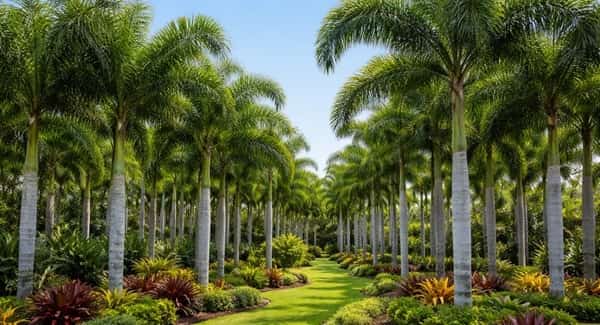
In everyday gardening language these are often called palm “varieties,” although botanically most entries below are separate species rather than cultivars of one tree. That distinction matters because their climate needs, size, uses and management differ greatly. Choosing the right palm can mean the difference between a long-lived, useful landscape tree and an expensive planting mistake. Now, let’s check out the top 10 palm tree varieties in India.
1. Coconut Palm (Cocos nucifera)
The coconut palm is India’s most familiar and economically versatile palm. It dominates humid coastal landscapes and supports household cooking, beverage markets, copra, coconut oil, coir, handicrafts and plantation-based mixed farming. Tall, dwarf and hybrid types are grown, and improved selections continue to be released for tender nut, copra, oil and stress tolerance.
- Primary regions: Kerala, Tamil Nadu, Karnataka, Andhra Pradesh, Odisha, Goa, Maharashtra, West Bengal and island territories.
- Appearance & growth: A solitary trunk topped by long feather-like fronds; tall types can become imposing landscape trees, while dwarf material is easier to harvest.
- Main uses: Tender coconut water, mature kernel, coconut milk, oil, copra, coir, neera and ornamental planting.
- Growing traits: Best in warm tropical conditions with good drainage and reliable moisture. Spacing, irrigation and variety choice matter because the palm remains productive for many years.
- 2026 note: Recent ICAR-CPCRI releases include multipurpose and stress-tolerant coconut types such as Kalpa Suvarna, Kalpa Shatabdi, Kalpa Ratna and Kalpa Vajra.
2. Arecanut Palm (Areca catechu)
Arecanut forms the tall, slender vertical lines seen across many humid plantations in Karnataka, Kerala and the North-East. It is an important plantation crop rather than simply an ornamental palm. The straight trunk and compact crown allow farmers to combine it with black pepper, cocoa, banana and other intercrops under carefully managed systems.
- Primary regions: Coastal and Malnad Karnataka, Kerala, Assam, West Bengal and other humid belts.
- Appearance & growth: A slender, ringed trunk with a neat crown of pinnate leaves; mature palms require protection from severe moisture stress.
- Main uses: Commercial arecanut production and plantation intercropping; leaf sheath material is also used for biodegradable plates and utility products.
- Growing traits: Prefers humid conditions, fertile well-drained soil and dependable water. Young palms benefit from shade and careful moisture management.
- Improved material: ICAR-CPCRI has released several higher-yielding selections, including Shatamangala for tender and ripe nut processing.
3. Palmyra Palm (Borassus flabellifer)
Palmyra is one of India’s great traditional palms. Its massive straight trunk and fan-shaped leaves are strongly associated with Tamil Nadu, Andhra Pradesh, Odisha, West Bengal and other tropical regions. Unlike a nursery ornamental, palmyra is a rural multipurpose tree tied to food culture, craft traditions and livelihoods.
- Regional names: Palmyra, palmyrah, taad/tad, taal and panai, depending on region and language.
- Appearance & growth: Very tall, sturdy trunk with a crown of large fan leaves. It is slow-growing and takes years to reach full productive size.
- Main uses: Sweet sap or padaneer, palm jaggery, ripe fruit pulp, tender seed kernels, leaves for traditional products and trunk material.
- Climate & resilience: Well adapted to hot conditions and can tolerate relatively dry environments once established.
- Cultivation note: Tamil Nadu Agricultural University has developed SVPR 1, selected for improved padaneer and jaggery recovery.
4. Date Palm (Phoenix dactylifera)
The date palm has moved from being mainly an imported-fruit association to a serious arid-zone horticultural crop in parts of western India. Rajasthan and Gujarat offer the intense summer heat and low humidity needed for good fruit development, while drip irrigation makes commercial orchards possible in otherwise difficult landscapes.
- Primary regions: Barmer, Jaisalmer, Bikaner and neighbouring arid districts of Rajasthan, along with Kutch and other suitable parts of Gujarat.
- Appearance & growth: A rugged palm with arching pinnate leaves and a thick trunk; male and female flowers occur on separate plants.
- Main uses: Fresh and semi-dry dates, processed date products and high-value desert horticulture.
- Important cultivars: Commercial planting material in India includes Barhee, Khuneizi, Khalas and Medjool in suitable belts.
- Growing traits: Requires high heat for ripening, controlled irrigation and reliable female planting material. Tissue-culture plants are widely preferred for true-to-type orchards.
5. Oil Palm (Elaeis guineensis)
Oil palm is grown for commercial edible oil production and should be viewed very differently from a low-maintenance landscape palm. Its productivity can be extremely high, but so are its water and management requirements. Successful cultivation depends on matching the crop to rainfall, irrigation, soil depth and processing infrastructure.
- Primary production zones: Selected high-rainfall or assured-irrigation belts in southern, eastern and western India.
- Botanical type: African oil palm, with heavy fresh fruit bunches containing oil-rich mesocarp and kernels.
- Main uses: Palm oil and palm kernel oil for food processing and industrial uses.
- Best planting type: Tenera is the standard commercial hybrid type, produced from Dura and Pisifera parents; it combines a thinner shell with high mesocarp and oil content.
- Growing traits: Needs warm temperatures, deep well-drained soil and abundant, dependable water. It is not appropriate for water-scarce sites without assured irrigation.
6. Fishtail / Toddy Palm (Caryota urens)
Fishtail palm is instantly recognisable because its leaflets resemble the split tail of a fish. In India it has both ornamental and traditional value. Tall specimens create a dramatic tropical effect, while in some regions the inflorescence sap has long been tapped for sweet sap, jaggery or fermented products.
- Regional identity: Known as fishtail palm, toddy palm or kithul in different parts of South Asia.
- Appearance & growth: Tall solitary palm with unusual triangular, jagged leaflets and long hanging flower clusters.
- Main uses: Landscape specimen, sap tapping in traditional systems and limited starch/fibre uses.
- Growing traits: Performs best in warm, reasonably moist conditions and needs enough space because mature fronds and flower clusters are large.
- Important caution: Caryota palms flower sequentially and the main stem eventually dies after completing its flowering cycle, so they should be planted with this life pattern in mind.
7. Wild Date / Indian Date Palm (Phoenix sylvestris)
The wild date palm is native to the Indian subcontinent and deserves more attention in discussions of indigenous palms. It has a strong, slightly rugged form and can survive in conditions that would be unsuitable for moisture-loving plantation palms. Traditionally, its unopened flower clusters have also been tapped for sweet sap.
- Regional names: Wild date palm, Indian date palm, desi khajur, jungli khajur and regional names such as nilan thengu.
- Appearance & growth: Single trunk with a dense crown of bluish-green pinnate leaves; lower leaflets can become sharp spines.
- Main uses: Traditional sap tapping, local landscape use and ecological value.
- Growing traits: Adaptable to warm subtropical and tropical conditions and generally tougher than many ornamental palms once established.
- Best suited for: Large naturalistic landscapes, farm boundaries and sites where an indigenous-looking Phoenix palm is preferred.
8. Royal Palm (Roystonea regia)
Royal palm is one of India’s most dramatic avenue and institutional landscape palms. The smooth grey trunk, swollen green crownshaft and upright feather-like canopy create the formal tropical look seen around resorts, large campuses and broad driveways. It is impressive, but its eventual scale makes it unsuitable for cramped residential plots.
- Use in India: Widely planted as an ornamental avenue, resort and campus palm.
- Appearance: Tall solitary trunk with a smooth surface, prominent green crownshaft and symmetrical pinnate fronds.
- Main value: Architectural landscaping, entrance avenues and large open lawns where vertical height is desirable.
- Growing traits: Prefers warm climates, sun, reasonably fertile soil and regular moisture while establishing.
- Planning note: Plant well away from buildings, overhead wires and narrow pavements because mature height and falling old fronds require space.
9. Foxtail Palm (Wodyetia bifurcata)
Foxtail palm has become a favourite in modern Indian landscaping because it looks lush without the enormous canopy of a coconut or royal palm. Its leaflets radiate around the frond, producing the soft bottle-brush or fox-tail appearance that gives the species its name. It works especially well in villas, medians and hotel landscapes.
- Use in India: Popular ornamental palm in warm cities, residential projects, hotels and commercial landscapes.
- Appearance: Single clean trunk with full, plumose fronds that form an elegant rounded crown.
- Main value: Decorative avenue planting, focal points, poolside landscapes and medium-to-large home gardens.
- Growing traits: Likes bright sun, good drainage and regular watering during establishment; established palms tolerate short dry spells better.
- Best suited for: Gardeners who want a tropical palm look with a tidier crown than coconut and a more manageable scale than royal palm.
10. Indian Doum Palm (Hyphaene indica)
Indian doum palm stands apart because palms usually grow as a single unbranched trunk, while Hyphaene can branch above ground. That unusual architecture makes it botanically interesting and visually striking. It is far less common in nurseries than foxtail or royal palm, but it is a valuable choice for collectors, botanical gardens and dry tropical landscapes.
- Identity: Indian doum palm, a branching palm noted in Indian horticultural references.
- Appearance: Fan-shaped leaves and a trunk that can divide into visible branches, creating a sculptural silhouette.
- Main value: Specimen planting, biodiversity collections and distinctive dry-tropical landscaping.
- Growing traits: Best in warm, sunny sites with excellent drainage and sufficient room for long-term development.
- Best suited for: Large gardens, institutional landscapes and palm enthusiasts seeking something more unusual than common nursery palms.
Practical Buyer’s Guide: How to Choose the Right Palm
The best palm is the one that fits the site, not simply the one that looks attractive in a nursery pot.
- Decide the purpose first: For food and farm income, look at coconut, arecanut, palmyra, date or oil palm. For pure landscaping, royal, foxtail and doum palms are usually more appropriate.
- Check mature size: A young palm may look compact, but royal, coconut and palmyra palms eventually need considerable overhead and root-zone space.
- Match water to species: Arecanut and oil palm need dependable moisture, while date palm and palmyra are much better adapted to hot, relatively dry regions once properly established.
- Buy true-to-type plants: For commercial plantations, use certified or reliable planting material. Seedling variation can be large in crops such as date palm, and poor planting stock can affect productivity for decades.
Conclusion
India’s palms range from plantation crops that support rural livelihoods to architectural ornamentals that define modern tropical landscapes. Coconut, palmyra and date palm offer food and commercial value, while royal, foxtail and doum palms excel as landscape specimens. Choosing by climate, mature size, water need and purpose will give far better results than choosing by appearance alone.
Frequently Asked Questions
Q. Which palm tree is best for a home garden in India?
Foxtail palm is one of the most practical choices for a warm, reasonably spacious home garden because it has an elegant crown and is easier to accommodate than royal palm or coconut. Smaller clumping palms may be better where space is very limited.
Q. Which palm is most useful economically in India?
Coconut is arguably the most multipurpose because the fruit, water, kernel, oil, coir and sap all have commercial value. Arecanut, date palm and oil palm can also be highly important, but their profitability depends much more strongly on region, water and market infrastructure.
Q. Which palm is best suited to hot and dry parts of India?
Date palm and palmyra are among the strongest choices for hot, dry environments. Commercial date production requires high summer heat plus irrigation, while established palmyra is notably hardy and suited to many dry tropical landscapes.
Q. What is the difference between arecanut palm and the ornamental areca palm?
Arecanut is Areca catechu, a plantation crop grown for its nuts. The ornamental plant commonly sold as ‘areca palm’ is usually Dypsis lutescens, also called golden cane palm. They are different species with very different uses and growth habits.