 By Hemant Sharma
 Kolkata is not just a city—it is an emotion. Often called the cultural capital of India, Kolkata has a personality that feels alive, expressive, and deeply reflective. It is a city where history breathes through old buildings, where art spills onto streets, and where conversations about poetry, politics, football, and philosophy feel completely natural.
Kolkata doesn’t rush to impress. It reveals itself slowly. Once known as Calcutta, the city has witnessed colonial power, intellectual revolutions, artistic renaissances, and social movements that shaped modern India. These ten facts explore Kolkata beyond stereotypes and show why it remains one of the most intellectually and emotionally rich cities in the world.
1. Kolkata Was Once the Capital of British India
Kolkata played a central role in India’s colonial history.
From 1772 to 1911, it served as the capital of British India. During this period, the city became the administrative, commercial, and intellectual center of the empire.
This colonial past left behind grand architecture, wide avenues, institutions, and a complex social structure. Even today, the city’s layout and buildings reflect this layered history of power, resistance, and adaptation.
2. The Hooghly River Is Kolkata’s Lifeline
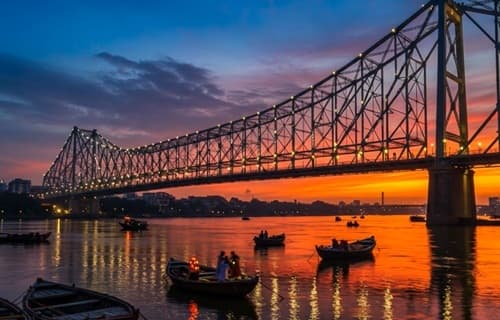
Hooghly River flows through the heart of Kolkata.
This river shaped the city’s economy, culture, and identity. Trade, transport, rituals, and daily life developed along its banks. Ghats along the river serve as places for prayer, conversation, work, and reflection.
Kolkata’s relationship with the Hooghly is emotional as much as practical. The river witnesses both celebration and sorrow, making it a silent companion to city life.
3. Howrah Bridge Is More Than a Bridge
Howrah Bridge is one of the most iconic structures in India.
Built without nuts or bolts, this massive steel bridge carries hundreds of thousands of people daily. It connects Kolkata with Howrah and stands as a symbol of endurance and engineering brilliance.
More than infrastructure, the bridge represents Kolkata’s rhythm—crowded, resilient, chaotic, and unstoppable.
4. Kolkata Is the Birthplace of India’s Intellectual Renaissance
The Bengal Renaissance began in Kolkata.
This movement transformed Indian society through literature, science, social reform, and political thought. Reformers, writers, educators, and thinkers questioned outdated practices and introduced modern ideas.
Institutions like universities, publishing houses, and debating societies turned Kolkata into a powerhouse of ideas—earning it the nickname City of Intellect.
5. Kolkata Gave India Its First Nobel Laureate
Rabindranath Tagore was born in Kolkata.
He became the first Asian to win the Nobel Prize in Literature in 1913. Tagore reshaped Indian literature, music, education, and philosophy.
His influence still defines the city’s artistic soul. Songs, poetry, schools, and cultural values across Kolkata reflect his vision of humanism and creativity.
6. Durga Puja Is Kolkata’s Grandest Expression
Durga Puja is not just a festival in Kolkata—it is a cultural phenomenon.
For several days, the city transforms into a massive open-air art gallery. Temporary structures called pandals showcase themes ranging from mythology to social issues.
This festival blends devotion, art, innovation, and community participation. UNESCO recognized Durga Puja as an Intangible Cultural Heritage, highlighting its global cultural importance.
7. Kolkata Has a Deep Love for Football
Cricket may dominate India, but football owns Kolkata’s heart.
The city’s passion for football is intense and emotional. Rivalries between clubs divide neighborhoods and families, yet unite the city in shared excitement.
This football culture reflects Kolkata’s working-class roots, community identity, and global outlook.
8. Trams Still Run in Kolkata
Kolkata is the only Indian city where trams still operate.
Introduced during the colonial era, trams are more than transport—they are moving heritage. Though slower than modern vehicles, they symbolize sustainability and nostalgia.
The tram system shows Kolkata’s resistance to erasing the past in the name of speed.
9. Kolkata’s Food Reflects Its Soul
Food in Kolkata is emotional, not just delicious.
From street food to traditional Bengali meals, the cuisine balances sweetness, spice, simplicity, and depth. Fish, rice, sweets, and snacks define everyday life.
Eating here is about conversation, memory, and comfort. Food is never rushed—it is shared and discussed.
10. Kolkata Lives Comfortably with Contradictions
Kolkata is old and modern at the same time.
It is crowded yet thoughtful, slow yet intense, struggling yet hopeful. Luxury buildings stand beside narrow lanes. Intellectual debates happen over roadside tea.
The city accepts contradiction as identity. It doesn’t hide flaws—it lives with them honestly.
Conclusion
Kolkata is not a city you merely visit. It is a city you experience—and once experienced, it stays with you. Its power lies not in skyscrapers or speed, but in memory, conversation, creativity, and emotional depth.
From colonial capital to cultural conscience, from riverside ghats to festival-lit streets, Kolkata continues to shape minds and hearts. It teaches patience, empathy, and reflection in a world obsessed with urgency.
Kolkata may not always be comfortable—but it is always real. And that authenticity is what makes it unforgettable.